Red Fort, Biryani and a Chandni Chowk Story

ARE YOU NUTS? You are going to Delhi in winter! Do you have any idea how cold it is out there? You’ll be frozen to death!' — was my friend’s astounded reaction on knowing about my plan to visit Delhi last month. I didn’t take his caution seriously. I had been to Darjeeling before in the month of January. Surely Delhi’s winter will be a lot more bearable, I thought.

As the first gush of chilly wind greeted me the moment I stepped out of the train, I realized my folly. It was around 7 in the evening and even with my pullovers on, I could hear my teeth chattering. Coupled with the cold wave, was a thick mantle of fog hanging over the entire city, making it look like one of those blurred photographs.

I was a kid (8 years, precisely) when I first visited Delhi. That’s when the love story kicked off, and every time I made a trip to Delhi I could sense the strengthening of the bond. There’s something irresistibly magical about the place — the more you delve into it, the more enticing it becomes — although I could never really figure out what it is.

Delhi is a lot like Kolkata. The city isn’t a single homogenous entity, but a multitude of existence closely intertwined. Conflicting and coexisting at the same time, you’ll find in Delhi paradoxes galore. And this dichotomy of the city’s character is what attracts me the most. Take a stroll through the bustling streets of Old Delhi, the labyrinthine lanes of Chandni Chowk and Chawri Bazaar, peep into Ghantewala halwai for a mouthful of sweets, or gorge on piping hot paranthas at Gali Paranthewali — you can’t help but fall in love with the place, almost instantly. However there’s more to the city than what exists within the walls of Shahjahanabad. The wide tree-lined boulevards, trendy cars, imposing buildings of Raisina Hill, the Georgian architecture of CP — the Delhi of Lutyens stands in stark contrast to the narrow lanes congested with cycle-rickshaws, dilapidated buildings still boasting of Mughal flavour and the old-age charm of Purani Dilli. Then there’s the new modern Delhi that resides in South Extension, GK, Malviya Nagar, Vasant Vihar — chic, upmarket and moneyed. It’s amazing to find a city having such a rich tapestry of history, heritage and modernity.

The Red Fort debacle

After reaching the hotel, I started making a plan for the next day’s sightseeing. The over-enthusiastic manager handed me a travel brochure containing a list of the most popular places of interest in Delhi. But since we had been to these places quite a few times before, this time we opted for the little known, lesser visited tourist spots. Tughlakabad Fort, Safdarjung Tomb, Khirki Masjid, Khuni Darwaza, Balban’s Tomb, Qila Rai Pithora, Majnu-ka-Tila, Razia Sultana’s Tomb, Haveli of Mirza Ghalib and Zeenat Mahal — the manager’s enthusiasm started wearing off before I could even complete the list.

'These places don’t fall within the regular tourist circuit, it’ll cost you more money,' he tried hard to deter us.

'We’ll see the Red Fort as well. That was left out last time,' I was adamant.

'But woh road toh abhi bandh hain! The Republic Day parade rehearsals are going on there,' he smiled (in relief, of course).

'I know, still...' I was losing ground.

Then came the knockdown.

'What will you do seeing the Red Fort? You’ve visited Agra Fort and Fatehpur Sikri na? Imagine those two monuments and combine them in your mind. Bas, ban gaya Red Fort!'

Phew.

Biryani like never before

After visiting Jama Masjid I instructed our driver Irfan to take us to Karim’s for lunch. This is perhaps the most legendary and immensely popular Mughlai restaurant in Delhi that even we, Kolkatans are well aware of. The location of the eatery is a little obscure although. It required quite a bit ‘asking people’ and ‘mazing through the lanes’ before we finally spotted it. A word of caution here: those expecting a magnificent building with stylish interiors will surely be disappointed. However, the food makes it up for everything else. For foodies like me it’s a gastronomic delight. Once seated, we ordered for Mutton Biryani, Shami Kebab, Chicken Noor Jehan and Kheer Benazir as dessert. I wanted to taste the hugely famous Badam Pasanda (boneless mutton cooked with yoghurt, almonds and spices. Yum!) but we were already so filled up that I had to sacrifice the mutton.

Despite running short of superlatives, the food was sheer heaven. Never before had I tasted Mughlai khana as khandani as this. The Biryani cooked in Awadhi style was a welcome shift from the Calcutta Biryani I’ve grown up on. Potatoes, an indispensible part of the latter is absent in the former. The chicken too was divine, so was the kheer. For all food-lovers visiting Delhi, here’s a must-do: eat at Karim’s. It’s a lifetime experience.

Telling tales of Chandni Chowk

On our way back, Irfan narrated some bizarre tales of conning people (outsiders, mostly) at Chandni Chowk — the ‘con heaven’, according to him. The shopkeepers here find some way or the other to fool customers, and sometimes in quite unique ways as well. Once he was standing outside his car while keeping his mobile on the dashboard. Suddenly a boy appearing from nowhere asked him to pick up a 10-rupee note that was lying near his feet. 'It wasn’t mine; still I picked it up,' said Irfan. But as he stood up, he realised his foolishness. The boy had disappeared, and so had his mobile!

Shopkeepers in Chandni Chowk have a freakish way of selling things. They will cry ‘ten bucks for a T-shirt’ as you walk past the shops. Curious, you might halt to get a closer look. That’s the bull’s eye moment. Within no time you’ll find a T-shirt landing on your shoulder and the shopkeeper demanding that you’ll have to buy it since you have already tried it out! Pissed off, you might even agree to buy it for 10 bucks. And here comes the double whammy. The shopkeeper will invariably charge you 100 bucks, arguing that you hadn’t heard him correctly! 'Banda bargain karega bhi toh kitna?' chuckled Irfan.

That’s Delhi. Love it. Hate it. You can’t help but get captivated by it.

One Photo Please!

PHOTOGRAPHY IS OUR national passion. It’s in our genes, actually. Every single memory — happy or sad — is expressed in terms of photos. Hey, have you been to Agra? Haan yaar, went there for my honeymoon. Wait, I’ll show you the photos — right away comes a picture of the husband and wife standing in front of the Taj Mahal, holding hands and grinning. Pati, patni aur woh!

Now that’s what you call a photographic memory (no pun intended), don’t you?

‘Person’ and not the ‘place’ is all that matters while taking pictures — the golden rule of great Indian photography. You may visit anywhere — Delhi or Dubai, Varanasi or Vancouver — but do remember to take pictures with you in the frame. Always. The background is immaterial. You might be standing in front of the Taj, but more than the monument it’s you who is important. Shah Jahan’s creation might get out of focus, but not you. Never. Else you are in deep trouble — Arrey, you visited the Taj Mahal? Then how come you aren’t there in any of the photos? What’s the point in taking pictures of the monument only?

The logic is quite simple. Your photos act as a proof that you actually visited the place (yes, you read it correctly). Few weeks back a Facebook friend of mine uploaded some pictures of his trip to Delhi, and as expected he was present in each of them. No Red Fort, Qutab Minar, nothing. It was him everywhere. Looked as if the guy had done an entire photo shoot over there. In fact, had it not been for the lone India Gate in the background of one of his photos, I would have had enough reason to believe that the pictures were taken in the backyard of his house.

I wonder why people can’t concentrate on the beauty of the place (instead of their own) while taking snaps. Is it so important to make ‘human’ presence visible in each and every frame? Let your camera capture the splendour and picturesqueness of the place, the way it actually is. Why tamper it with artificiality? Good travel photography should attempt to capture the essence of the place, not mar its serenity with mindless look-at-me poses. I would any day prefer a snap of the Taj Mahal alone than that of an oh-so-romantic couple standing in front of the monument in an oh-so-appalling manner. The latter takes away the elegance of the subject (the Taj, that is) overcrowding it with unnecessary objects. However, this doesn’t mean that I’m against so-called ‘family vacation pictures’. They do conjure up fond memories of holidays. But can’t they be kept natural?

Unfortunately, in most of such pictures you’ll notice three distinct features: people standing in awkward ‘attention commandos’ posture, their eyes fixated on the camera lens and a stupid smile on their otherwise stiff faces — Everyone come closer... Dolly don’t move beta!... Pinku look at the camera and don’t blink... now all of you say cheese! Urghhh.

Posing for photograph — that’s something everyone (there’s no diversity in this unity) is quite fond of. And therefore you will find some of the most bizarre poses ever seen. I still remember a photo taken at the Taj Mahal where the husband and wife were facing each other with the Taj in between and — here comes the surprise — both their hands raised above in a gesture of touching the tip of the monument! A little trick photography can do such ‘monumental’ wonders (and you thought one needs to be a Raghu Rai to take mind-boggling snaps). Dumb.

I’ve long been labelled as a high-brow aantel by my family and friends since I refuse to take their pictures during our vacations. Ki shudhu rasta-ghat gaach-palar chhobi tule beras? Take our pictures too! — laments my mom often. But I’m glad there are still some people who think otherwise. During my recent trip to Delhi I met two elderly Iranian women, who asked me to take their photo with the Qutab Minar in the background. As I asked them to come closer in the frame, one of the women said, ‘Keep it like that. We are not important, the place is.’ Her statement said it all.

Blame it on the Name Anyway

HOW DO YOU spell 'Kolkata'? Or pronounce it?

No, this isn't a test of your English spelling and pronunciation skills (and nor have I gone crazy). It's actually one of those just-like-that random questions, having an amazing ability to freak people out. Sounds bullshit? Well, throw this question at anyone you like (or dislike), and you're sure to get back a lot of zany answers.

I did just that. Over the past few days I did what Desmond Morris often does — people watching (stop bulging your eyes silly!). I noticed the way people say 'Kolkata'. or write it. And boy, the results were mind-boggling! I never knew this city had such a great degree of flexibility of its name.

You might argue, what's the big deal in the name Kolkata? Why make an issue out of it? It's as simply spelt as K-o-l-k-a-t-a, and pronounced as Coal-kata. Right?

Wrong. One the contrary, the name gets distorted so often that I doubt whether there's really a consensus on what should be the actual spelling or pronunciation of it. The most common spelling of Kolkata is Kolkatta — embellished(!) with an extra 'T'. I recently saw a TV channel using that spelling in one of their telecasted shows. I even found the same spelling on the admission form of an educational institution. But why overburden the word with unnecessary alphabets? Is it a result of colonial hangover (of making Kolkatta sound almost a namesake of Calcutta), or an overdose of Ekta Kapoor soap operas? If latter is the case, then someday the city might end up as Kkolkatta! And coming to verbal expression, sample these — Call-kata, Call-kota, Call-katta, Kal-kata. Phew!

Do I sound Raj Thackeray-ish? Well, that's the last thing I would intend to, because the name gets messed up by everyone — Bengalis and non-Bengalis alike. No hard feelings for that. Kolkata, being essentially a Bengali word, it's difficult for those who don't know the language to get the right accent (after all, how many of us say Pa-ri instead of Paris?). So it's not out of anger or vengeance that I'm writing this post (did you think.... urghh!). It's actually quite amusing to find so many renditions of my city's name. And then, most importantly, pissing people off by mindless questions has a charm of its own! Like I said, it's one of those freaky just-like-that random questions.

So, how do you pronounce Kolkata? Or spell it?

Our Story, Our Way

I’M IN A trance. Its one of those rare ‘the-world’s-such-a-beautiful-place-to-live-in’ ecstasies, when you fall in love with almost everything you stumble upon — from the hideous Sweety next door who appears to be India’s best contender for Miss World to the grumpy uncle downstairs who resembles Father Christmas. But what’s most surprising, I suddenly find Punjabis and Tamilians the two most lovable communities like never before.

No, I haven’t snorted coke. Nor have I experienced any spiritual awakening. I’ve just finished reading a novel. A Chetan Bhagat novel, to be more precise. Four hours at a stretch, and Bhagat’s latest book has once again left me spellbound. Aptly titled 2 States: The Story of My Marriage, Bhagat’s humorous take on the institution of marriage in India makes an immensely enjoyable read. Smart, funny, pacy and refreshing, 2 States makes you break into peals of laughter while at the same time keep your fingers crossed to see Krish and Ananya finally getting married. This man surely knows how to strike a chord with his readers!
2 States, based on Bhagat’s own inter-caste romance and marriage, is about a Punjabi boy getting married to a Tamilian Brahmin (yes, you read it right). As expected, there are a lot of jokes thrown in about these two at-loggerheads communities, which keeps you captivated till page 269 (that’s the last page, silly!). But at the same time Bhagat has authentically portrayed the Punjabis and Tamilians, never letting them look caricaturish. My visits to Chennai and Delhi have given me a glimpse of both their worlds and it’s amazing to find how detailed Bhagat has been in his observations.

After Five Point Someone Bhagat is back to what he do best — unadulterated humour, and this time his pen is more mature. I’m a huge fan of his writing although I felt Bhagat’s last two offerings failed to reach the high benchmark set by his debut novel. One Night @ the Call Center was engrossing but the ‘call from God’ stuff gave it a far-fetched feel. The 3 Mistakes of My Life turned out to be grimmer than I had expected. However the greatest shock came with the Salman Khan-starrer Hello that was the film adaptation (!) of One Night @ the Call Center. Honestly, it’s one of the shittiest films I’ve ever seen. But what saddened me the most was Bhagat’s name as one of the screenplay writers. Why on earth did he let his star novel be filmed by an obscure Atul Agnihotri?

Thankfully 2 States is nothing of that sort. It’s vintage Bhagat. Krish and Ananya stays with you long after you have kept the book back on the shelf, just like Hari, Ryan, Alok and Neha. Even the other Punjabi and Tamilian characters are so endearing that you fall in love with them almost instantaneously. However, I longed for some more ‘IIM moments’ in Krish and Ananya’s life. They seemed too brief! Also, as a friend of mine rightly pointed out, the transformation of Krish’s father was too abrupt to be believable. His sudden visit to Chennai and convincing Ananya’s parents for the marriage looked irksomely filmy. But then the heart of the book is so much in the right place that you don’t take the flaws to heart.

Ever since this former investment banker forayed into the world of Indian books, he seems to have transformed the country’s literary landscape. People often complain about Bhagat’s bad English, hackneyed plots, filmy endings, but buy him in enormous numbers. He is panned by the critics as merely a ‘popular fiction’ writer — someone who doesn’t deserve to be placed in the Ivy League of literature. His books are for entertainment not for the intellect, they claim. I agree. But what’s wrong with that? I enjoy reading Bhagat for the simple reason that I can identify myself with his characters. His simplistic writing makes you crave for more. In fact, I would prefer a 2 States anyday than some pseudo-intellectual stuff that would piss me off halfway.

Bhagat is called the ‘youth icon’ of today. Is it because he tells our stories in our language? Or is it because he makes everyone — right from the rich Mumbai college kid to the gawky teenager of Bastar — get absorbed in his books? Whatever may be the answer, Bhagat’s stories have succeeded in doing something that many highbrow novels fail to achieve — bring a smile on your face. Is that too trivial an achievement?

Image courtesy: http://www.chetanbhagat.com/

Waking Up from a 3-hour Sleep

IT SEEMED LIKE an eternity since I had entered the multiplex. Three hours into the film and my senses were almost numb. Suddenly a man snoozing beside me woke up. ‘The movie isn’t over yet? My God, I’ve been sleeping here for the past 3 hours and it’s still continuing! Aar para jachche na!’ said the man to his wife. The frustration in his voice touched my heart. After all, I too shared the same feeling! On my way back home I kept on thinking who my worst enemy is, so that I can avenge myself on him by sending him a free ticket for WHAT'S YOUR RAASHEE?
Surprised? Don’t be. I’m a big fan of Ashutosh Gowariker gharana of filmmaking. But unlike his previous ventures What’s Your Raashee? falls flat on its face. A new player in the genre, Gowariker tried to make a breezy rom-com, but the film turned out to be neither rom nor com.

Harman Baweja trying to find the ‘perfect bride’ from each of the 12 sun signs within 10 days made an interesting premise. Priyanka Chopra in 12 different avatars added to the interest. But Gowariker the writer fails miserably to captivate the viewers. The stories involving each of the girls get monotonous, tiresome and way too long. A majority of the 12 Priyanka Chopras turn out to be clichéd and sketchy. In giving too much importance to the initial girls, the latter ones are reduced to ‘blink-and-you-miss’ mannequins. There are too many loopholes in the screenplay to ignore. The climax is unconvincing and filmy. Even the funny one-liners look forced upon, and the romance is nowhere to be seen.

However, the villain of the piece emerges to be the editor — Ballu Saluja. I don’t have any problem with a 3.5 hour long film, provided the story is an absorbing one (sample: Jodhaa Akbar). But since that’s not the case with What’s Your Raashee?, the length of the film should have been trimmed down. Gowariker needs a new editor, immediately!

The saving grace in this bore-drama is Priyanka Chopra. The way she enacts the 12 girls is pure magic. I particularly liked the intense Cancerian, the downmarket and heavily Gujju-accented Aries, the bossy Libra, the Swades-hangover Virgo doctor and the innocent little Capricorn girl. Harman Baweja looks nice and acts well, but he couldn’t add any zing to Yogesh Patel. Unlike what many have said, I quite liked Sohail Sen’s music (of course, you can’t expect a Lagaan or Jodhaa Akbar from Sen). Jao na, Bikhri bikhri, Su chhe, Koi jaane na, Chehre jo dekhe hain — some of the songs stay with you even after you have left the theatre.

From a master storyteller like Gowariker I expected something more than this staid contemporary love story. Perhaps the man should better stick to his forte — Mughal family dramas. Experiments are not meant for everyone.

A few days after the What’s Your Raashee?-debacle, I went back to the same plex for yet another rom-com, Ayan Mukerji’s WAKE UP SID. Not another bore-flick, I prayed as I entered the theatre apprehensively. But boy, I got more than I asked for! No OTT Karan Johar melodrama (there were high chances of it since KJo is the producer of the film), no preachy messages — Wake Up Sid is a beautiful love story woven into refreshing coming-of-age tale.
The film is all about Sid, a lazy unmotivated slacker from Mumbai whose carefree world undergoes a series of changes after Aisha walks into his life. She acts as a catalyst in transforming Sid from an irresponsible boy to a responsible man. Coupled with this is a mint-fresh love story between two very different individuals which touches your heart deep within.

But then you might ask, what’s so new about it? Okay, I agree the story is predictable. Right from the beginning you know that Sid will, by the end, wake up to his responsibilities and he and Aisha will live happily ever after. But the difference lies in Ayan’s smart screenplay. The characters appear so realistic and endearing. Midway through the film my friend exclaimed, ‘Sid in the first half resembles me! It’s actually my life story dude!’ That’s exactly where the film succeeds. We can relate to it. There’s a Sid in all of us. We’ve all been in that phase where life is floating by and we are aimless. Kudos to Ayan for gifting us a slice of our own life.

The director once said that he’s a great fan of Farhan Akhtar. True, Wake Up Sid has moments that are inspired from Akhtar’s Dil Chahta Hain and Lakshya. But nevertheless, the film’s earthly flavour and its close-to-life essence make Wake Up Sid an engaging watch.

The lead players, Ranbir Kapoor and Konkona Sensharma, give stellar performances. Every time they come together they exude infectious warmth that gets on you, and you keep on longing for more of Sid and Aisha. It’s the duo’s chemistry that’s a high point of Wake Up Sid. I wonder, how Konkona manage to look so good with all her leading men (of all age groups), be it Rahul, Kunal, Irrfan or Ranbir! But there’s one thing that irked me. Aisha is born and brought up in Kolkata, why then she reads Tagore in English and talks to her mother in accented Bengali?

Shankar, Ehsaan and Loy try hard to give a lilting score and they manage to do it as well, but it’s Amit Trivedi’s soulful Iktara that steals the show all along. What the trio couldn’t achieve with almost half a dozen songs, Trivedi did just that with a single blow. Thanks to Javed Akhtar for penning such wonderful lyrics, although he sounded a bit Gulzar-ish in the song!

Even if Wake Up Sid was a crap film, I would have loved to watch it again and again. Not because of Ranbir-Koko, but because it uses something to unite the lovers that’s closest to my heart — monsoon.

Shaktirupena Sansthita

THE COUNTDOWN HAS begun. The wait is in its final lap. The end of pitripaksha has ushered a new dawn — the dawn of devipaksha. With preparations almost over, there’s hardly a few days left. One more year, and its time again for homecoming — for Durga, as well as for millions of Bengalis, for whom the festival isn’t just another religious ceremony. It’s much more than that. So everywhere you go now, there’s just one emotion — aha ki anando akashe batashe. After all, Maa aschhe!

Durga puja — the grandest of all Bengali celebration. This is one occasion every Bengali — be in Kolkata or Kolhapur, New Delhi or New York ­— look forward to throughout the year. As soon as we get the year calendar, the first thing we notice is the schedule for Durga Puja, undoubtedly!

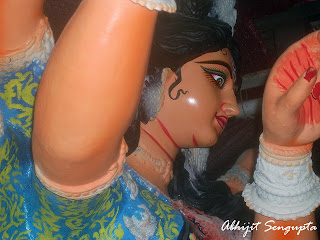
Recently I went to my para pandal to get a glimpse of the puja preparations. What I saw over there was amusing. The entire area looked like a scene of frenetic activity. Be it the panic-stricken club officials pacing up and down the field restlessly or the poker-faced labourers busy giving finishing touch to the pandal — I seemed to be amidst a whirlpool of frenzied activity. If this is how a puja pandal looks like, what would be the situation in the potters’ colony, I wondered. Curious to get a first hand experience, I visited Kumortuli a few days back (for toddlers, Kumortuli is the potters’ den of Kolkata — the place where the clay Durga idols are made). Well, Kumortuli wasn’t any different either. It’s the same hysteric hullabaloo, resembling the backstage minutes before the start of a fashion-show.

Nevertheless I got some snaps there that, when developed, turned out to be quite interesting. A slice of life at Kumortuli, these pictures give you a sneak peek inside the factory of idol-making. Though unfinished, these Durga idols appeared far more appealing to me than the ones in pandals. So as they say, pictures speak a thousand words than written alphabets, its time for me to shut up! Let the images do the rest of the talk. And hey, while checking out the pictures don’t forget to hum the best anthem of Durga puja ever made — Bajlo tomar aalor benu...
Here comes the Devi...

...And the city awakens

Waiting for the finishing touch

Durgatinashini

The goddesses' battalion

The journey begins... again

Tamaso maa jyotirgamaya

It's his puja too

Chestnutted Love for the ‘Mango People’

I KNOW I’LL be damned forever for saying this, but Imtiaz Ali has lost his magic wand. However blasphemous it may sound like, Love Aaj Kal appeared to me as a soulless film. What was touted as the year’s best romantic comedy fell quite short of my expectations.

But wait! Aren’t we talking about a romantic film here? A soulless love story... does that make any sense? No, it doesn’t. And that’s precisely the irony with Love Aaj Kal. It has all the ingredients of a good romantic film, but it fails miserably in satisfying the most important criterion. Love Aaj Kal doesn’t make you fall hopelessly in love with it. Jab We Met did. Socha Na Tha did it too. So then what went wrong with Love Aaj Kal?

Imtiaz Ali is one of my favourite directors. He’s the man who redefined ‘love’ on Indian screen, stripping it of all the filminess we have endured over the years. Ali makes all his love stories look so believable — the plot, the situation, the characters, the way they behave, talk, react, fall in or fall out of love. Add to it a pinch of innocence and you can’t help but fall head over heels in love with them — be it Viren, Aditi, Aditya or Geet.

This confused me even more. Love Aaj Kal isn’t a crap film. Its Ali’s most ambitious and complex take on love till date, spanning two generations and three continents. But still there’s something that’s missing in the film. What is it? I don’t know. It may be the merging of the two love stories that was jarring at times. It may also be the post-interval portions that slipped into high-voltage melodrama, spoiling all the freshness Ali had built up so long. Or may be its the OTT depiction of Veer Singh's ‘pure love’ versus Jai's ‘practical love’ that was too preachy to handle.

Or is it Aditya and Geet whom I missed so badly that I tried in vain to find them in Jai and Meera in every frame of the movie?

I usually refrain from comparing one film with another. Every film is distinct in itself and there’s no point in making ‘oh-I-wish-Ghajini-was-as-good-as-Taare Zameen Par!’-type comments. But then when you have set a benchmark for yourself, you cannot afford to slump down! Imtiaz Ali did just that. He tried to make a smart, cool, fast-paced rom-com and so like all typical Hollywood rom-coms, Love Aaj Kal too boasts of some really witty one-liners, glossy shots, rich sets, loveable music and fine acting by its lead players. But somewhere in its swanky smartness it lost its innocence... its soul. Unlike Ali’s previous two films, Love Aaj Kal is more brain, less heart. Everything in the film looked too forced upon, the natural feeling of Jab We Met was surprisingly absent. You feel happy to see Jai and Meera getting reunited in the end, but forget it as soon as you step out of the theatre. They don’t linger in your memory like Aditya-Geet or Viren-Aditi.

Deepika was a revelation. With her vivacity, elegance and a smile that’s highly infectious, she was the perfect choice for Meera. However I missed Aditya. Saif tried too hard to bring back the Karan-effect of Hum Tum, but the déjà vu was too strong to ignore. Besides he looked pretty old as compared to Deepika (sorry, I couldn’t find any sugar-coated word). Giselle was stunning until she spoke (thankfully Ali had given her a handful of lines to deliver). Rishi and Neetu Kapoor were sweet as ever.

Imtiaz Ali once said that when he looks back today he finds a lot of loopholes in Jab We Met. He simply went with the flow while writing the script. I wish he had done just the same this time too. Some love stories aren’t meant to be logical.